Showing posts with label Traditional Hanfu. Show all posts

Sunday, January 10, 2016

Matching Outfits

After dressing up the beautiful traditional Chinese clothing with adorable accessories, in order to make them look special and prettier in different seasons, ancient Chinese people will put on some matching outfits as well. I would like to introduce two most common types of matching outfit today: big sleeve unlined upper garment and cloak.


Big sleeve unlined upper garment:

The big sleeve unlined upper garment was created in Tang dynasty along with the Qixiong Ruqun, which I mentioned in the previous post. It was initially designed to match the Ruqun clothes in summer. Just as its name indicates, the main feature of it is its broad sleeves. For the sleeves of this clothing, not only the length should be at least 78 inches, but also the width ought to exceed 40 inches in order to reach the standard level. The material of the big sleeve unlined upper garment is generally thin and light, like silk, because people only wear it for beauty in the summer. It is more like a decoration rather than a clothes.


Here is a picture of big sleeve unlined upper garment:


Cloak:

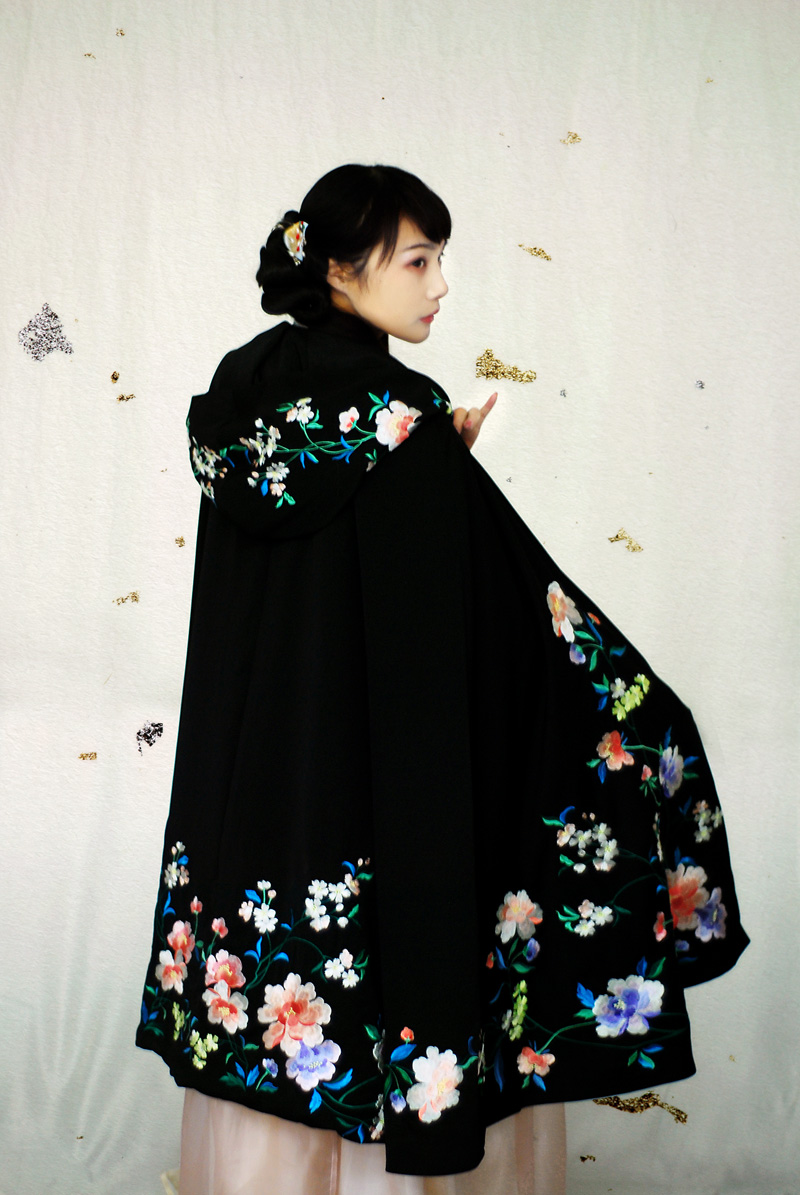
The cloak was created to prevent people from wind and snow in winter. It can be rather long enough to reach the ankle or short enough to only exceed the hip. In order to make it seem warmer, people usually put animal’s fur around the cloak. Also, they usually embroider on it in order to make it prettier and more special. Nowadays, the cloak gradually becomes thinner and thinner so that people can wear it either in autumn or in spring as well.


Here are some pictures of cloak:


Thursday, January 7, 2016

Underwear

Do not ever belittle the wisdom of our ancestors. Although they lived a thousand years ago, they’ve already figured out the importance of underwears. In fact, females in ancient China need to dress at least two layers of underwear before they put on the outerwear. Today, I will to introduce those two layers of underwear: the inner clothes and the middle clothes.


Inner clothes:
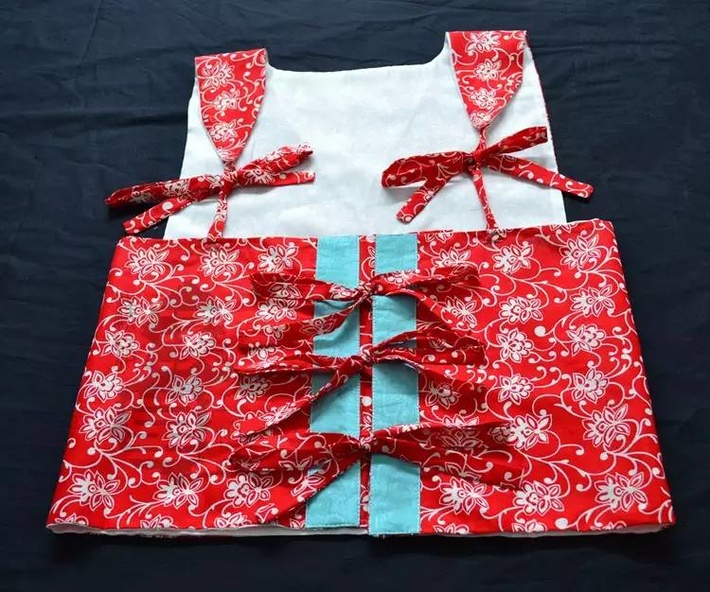
The inner clothes are only required for females in archaic society, because China is a country which people look up to men and down on women. They believed that women should wear more to cover their bodies. The inner clothes play a role as a brassiere does in the contemporary society, but they are longer and thicker. They can cover not only the breasts, but also the belly, which means that it looks like a vest. However, forms of inner clothes changed with dynasty, so there are no typical inner clothes for traditional Chinese clothing.


Here is a picture of one of the inner clothes:


Middle clothes:
The middle clothes are suitable for both males and females. They are designed in the same way as the normal Ruqun that I introduced in the second post. It is generally white in order to fit all the outfit colors. Regardless of the fact that it looks like a normal Ruqun, it can only be worn inside of the other clothes. Going out with only the middle clothes will be regarded as impolite and indecent in ancient time. However, it can be dressed as pajamas while people were sleeping or just staying at home, also, people are required to dress the middle clothes while they were dressing the formal attire for important events.


Here is a picture of middle clothes:

Source: Lady Xi

Tuesday, January 5, 2016

Curving-front Garment

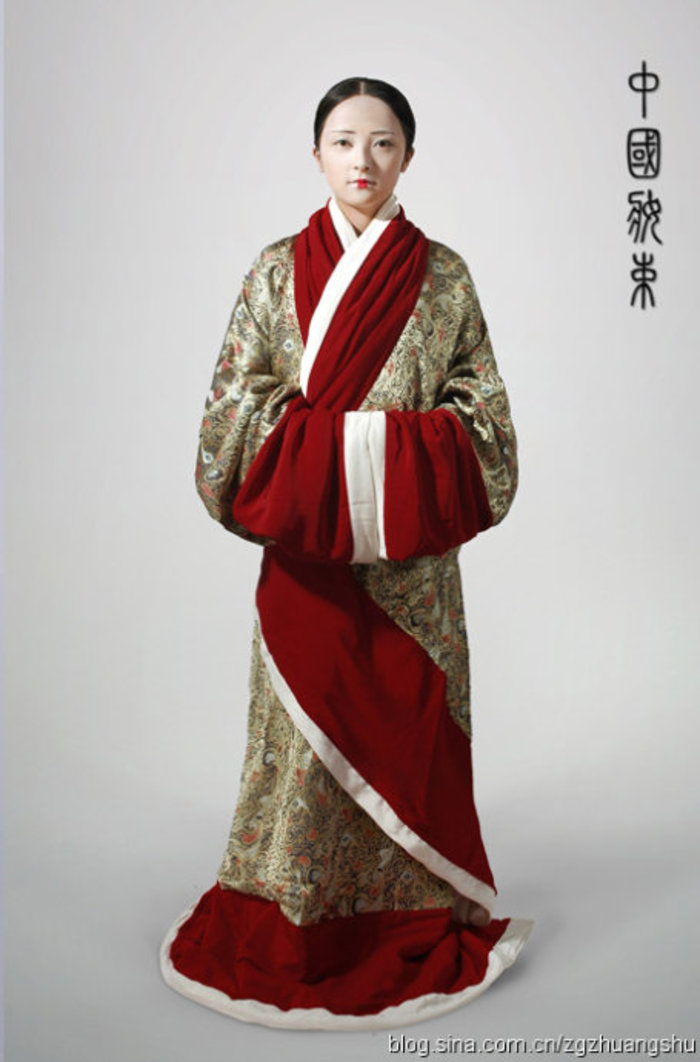
Qin dynasty is the first official dynasty in China. People gradually began to get rid of the barbarian lifestyle during the Qin dynasty. During that time, they invented the curving-front garment, the most ceremonious Han clothing which was also known as Quju. It is suitable for both male and female, and the most noticeable feature of Quju is its diagonal body wrapping.


Here is a picture of curving-front garment:

Argument:
While modern Chinese started to recreate the traditional Chinese
clothing, they argued a lot about the form of curving-front garment. The argument can be divided into two parts. On the one hand, someone believed that the length of the sleeve on curving-front garment should be as short as most of the modern clothes, but the researchers argued that ancient people actually prefer long sleeve, because it can pretend them from wind and cold. It also looks more elegant while the sleeves are long enough to hide people's hand. Acting in accordance with their research, the sleeves should be at least 75 inches long.


On the other hand, someone insists to make the bottom of curving-front garment like a curve, because they think it looks beautiful this way. However, now some expertises argued that the bottom should be straight, because our ancestors wanted to indicate that it is essential to be an upright person. What's more, this design can make the clothes tenser while walking, so people will look gentle and elegant if the bottom is straight.


However, overall, even if there exist a lot of argument around the curving-front garment, we can't deny that it is one of the most important forms of traditional Chinese clothing. People ought to wear it in those important, serious situations because they seem sacred in it.

Tuesday, June 9, 2015

Round Collar Robe

Most types of Han clothing that we had talked about in the past few weeks are mainly for the females, but as I mentioned before, the Han clothing as the traditional Chinese clothing is not only designed for females, I would like to talk about one important type of Han clothing that is mainly designed for males--Round Collar Robe.


Here is a picture of Round Collar Robe in an ancient wall painting:
Features
The round collar robe was created in Tang dynasty, and it became extremely popular at that time as well, so it was also known as “Tang Round Collar Robe”. It was designed only for males to wear at first. But because this robe can make people look taller and thinner than his original body, which exactly satisfy the females’ need, so it gradually become popular among females as well.


Also, because the round collar robe is designed as a coat, it is usually loose so people can wear underwear in it. And it is convenient to wear for the daily life because it is not as long as the other dress, it allows us to see people’s feet. So, when the females are wearing it, they have to put on a pair of boots instead of normal shoes, because in ancient China, the females’ feet are not allowed to be seen by others except their own husbands.


Here is a picture of Round Collar Robe in the contemporary society:

However, in the contemporary society, in order to make the round collar robe more convenient, some designers made changes on it, they cut it shorter and put more beautiful pictures on it, which makes it looks pretty and handsome. And because nowadays, the female masculinity becomes more and more normal, so the round collar robe is now also more popular among females than males.

Tuesday, June 2, 2015

Accessories

Ancient Chinese women love to make themselves look beautiful and attractive as well, but they cannot do that without accessories, today I want to introduce the accessories that they used to put on while dressing the Han clothing. There are two main categories of the accessories in ancient China: the hairpin and the hand ornament.


Hairpin
Ancient Chinese women liked to have long hair, so they can put their hair in a bun to make them look more elegant. The hairpins are usually just a long, thin wood stick with some fake flowers on one point. When using it, just put the empty and shark side into the hair bun, because the hairs are all gathered in the bun, they will lift the hairpin and will not let it fall down.


Because our ancestors believed that flowers are the most beautiful natural things in the world, so they encouraged women to put on something that contain flowers to make them look more amazing. When they walked, it looks like that the flowers are actually growing on their heads.


Here are pictures of hairpins:
 
Source: Mega


Hand Ornament
The ancient Chinese hand ornaments are usually made of pearls, some of them are short, some of them are long. We prefer to wear the long hand ornament so we can hold part of it in our hand and play with it, because we believed that it can make us look smarter.


Also, because the Han clothing all have long sleeves, the long hand ornaments can prevent the long sleeves from covering our hands and influencing the daily life. They are both beautiful and useful.


Here are pictures of hand ornaments:
Long hand ornament

Short hand ornament


Overall, the ancient Chinese women tried really hard to make them look more attractive, and they succeed, the classical beauty of ancient China can never be replaced or exceed.

Tuesday, May 26, 2015

Aoqun

I have already talked about Ruqun--the clothes that ancient Chinese people dressed mostly in spring, summer, and fall, now I want to talk about what are people, especially women are going to wear in Winter: Aoqun. Ao and Qun are the two main parts of Aoqun: Ao means the coat, and Qun means the skirt.


Ao (Coat)
There are two types of the coat “Ao”: the long Ao and the short Ao. The long Ao is always long enough to cover the knees, which is not convenient for acting and moving. So, most people prefer the short Ao instead, the short Ao should cover the waist at least to make sure that it can prevent us from the cold weather outside.


Also, both the long Ao and the short Ao have the crossed collar, and they always put the front of collar at right. And because the Ao is the clothes for winter, it has to in a double-deck structure, the inside cloth is always warm and comfortable while the outside cloth is always thick and beautiful.


Here are pictures of Long Ao and Short Ao:
 
Source: Back to Han

Qun (skirt)
The skirt “Qun” has a lot in common with the Qiyao Ruqun, which means that the waistband of it is on the waist instead of above the chest. The only difference is that people use much thicker cloth while making the Qun because it is a winter dress.


However, there is one special type of Qun in Ming dynasty named “Horse Face Qun”. As we can in the picture, both the front side and back side of this Qun are as flat and long as the horse’s face, this design will make the people in it look thinner and taller. But because it is hard to keep both sides as flat as new, people only dress it in the important festivals or ceremonies.


Here is a picture of Horse Face Qun:

Tuesday, May 19, 2015

Ruqun

Ruqun is the most basic type of Hanfu, it consists of a blouse and a wrap-around skirt. Generally speaking, people divide it into two types based on the height of the skirt: Qixiong Ruqun and Qiyao Ruqun.


Qixiong Ruqun
Qixiong Ruqun is the kind of Ruqun which the waistband of it is above the chest. It is only for women to wear.

Qixiong Ruqun was extremely popular in Tang dynasty. At that time, people believed that the fatter you are, the more beautiful you will be. So, they wore the Qixiong Ruqun to help them look more round. Because the design of Qixiong Ruqun requires to put the waistband above the chest, so others cannot see how thin the person really is inside the dress, the person will look as fat as her breast is.


Here is a picture of Qixiong Ruqun:

Qiyao Ruqun
Qiyao Ruqun is the kind of Ruqun which the waistband of it is on the waist. Both men and women can wear it.

Qiyao Ruqun was common in almost all the dynasties in ancient China. Because the main characteristics of it is convenient to wear, save cloth, and easy to make.

Here are two pictures of Qiyao Ruqun:

 
Source: Flying Bee


Common to Both

As we can see in the pictures above, when people wear Ruqun, they usually put a long cloth around their arms, people call it Brocade Scarf in China. At the beginning, people only used it as a scarf to prevent themselves from wind and cold air. However, as time goes by, it gradually becomes one important part of Han clothing, people used it to make themselves look more charming and mysterious.

Also, the sleeves of Ruqun are either tight or loose. Usually, people wear the Ruqun with tight sleeves for working to prevent their sleeves from getting dirty. And they wear the Ruqun with loose sleeves for relaxing because it the loose sleeves are more beautiful and comfortable to wear.

Here is a picture of Qiyao Ruqun with loose sleeves:

Tuesday, May 12, 2015

What is Hanfu?

Hanfu, also known as Han clothing, is the traditional clothing of the Han Chinese (Han: the main ethnic group of China) for more than 4,000 years. There are three basic characteristics of Hanfu, fastened by ropes or rope hookers, crossed collar and always put the front of collar at right.

Basic characteristics


Firstly, ancient Chinese people preferred to fasten the Han clothing by ropes or rope hookers because they believed that the ropes can decrease the damage to the cloth, so they use them instead of metals to protect the cloth and keep it smooth.

Secondly, most of the Han clothing has the crossed collar, which means to wrap the right side of the collar across to the left side. The point of intersection is right in the middle of the clothes, it encourages our Chinese to become an unprejudiced person. And based on the intersection point, we will make a straight line on the middle of the clothes, which encourages us to become an upright person.

Thirdly, Chinese ancestors believed that when do the crossed collar, it is necessary to always put the front of collar at right, in the other word, always wrap the right side over before the left to make it looks like a “y”. They made rules because of the initially greater challenge to the right-handed wearer. Also, Chinese discouraged to put the front of collar at left, they believed that it is unnatural, barbarian, uncivilized and unfortunate. Because in the ancient time, only the people from foreign minority nationalities wore the clothes in this way.

Here is a picture of the crossed collar and the middle straight line:


The Han clothing is now usually worn during some festivals, or coming of age of passage ceremonies, by hobbyists, by Taoist, Confucian or Buddhist monks and priests during religious ceremonies, or as a cultural exercise. However, the clothes that we usually see in Chinese television serials and films are not Han clothes, because they do not have those three basic characteristics.